In-house design agent or external tool: compare the full cost
A convincing prototype can become an expensive tool to maintain. Before building a design agent, compare the work needed to reach an approved deliverable and to sustain that quality over time. The price of a generation covers only a small part of the decision.
In this article
Compare the complete path from brief to approved file
First, define the work the team needs to finish. “Create a visual” leaves too much room for interpretation. A product announcement in three formats, with approved copy, editable text and a revision after review, gives you a comparable scope.
Add actual constraints: languages, destination tools, confidentiality and the person who approves the work. Establish whether the creative direction has already been chosen. Applying an existing composition and proposing a new campaign require different capabilities.
Use this scope as your trial protocol. Both options should produce the same deliverables with the same brand assets. You can then separate the cost of creation from the cost of configuration and corrections.
When building internally makes sense
An internal system can be appropriate when formats or integrations are unusual, a library already exists and a team can maintain the whole workflow. It gives you control over how resources are organised and tools connect. The trade-off is that the system becomes a product you own and operate.
Plan for permissions, generation failures, model updates, exports and changes to brand rules. A prototype that works with its creator is not yet a tool the entire team can use. Documentation and the ability to diagnose failures are part of the deliverable. Someone must also decide when a new version is ready and how to restore a previous working configuration.
What an external tool must demonstrate
An external tool may reduce integration work and provide a more approachable creation workflow. Still, test whether it respects the actual brand: components, typography, composition constraints and editing needs. A gallery of attractive examples does not establish that fit.
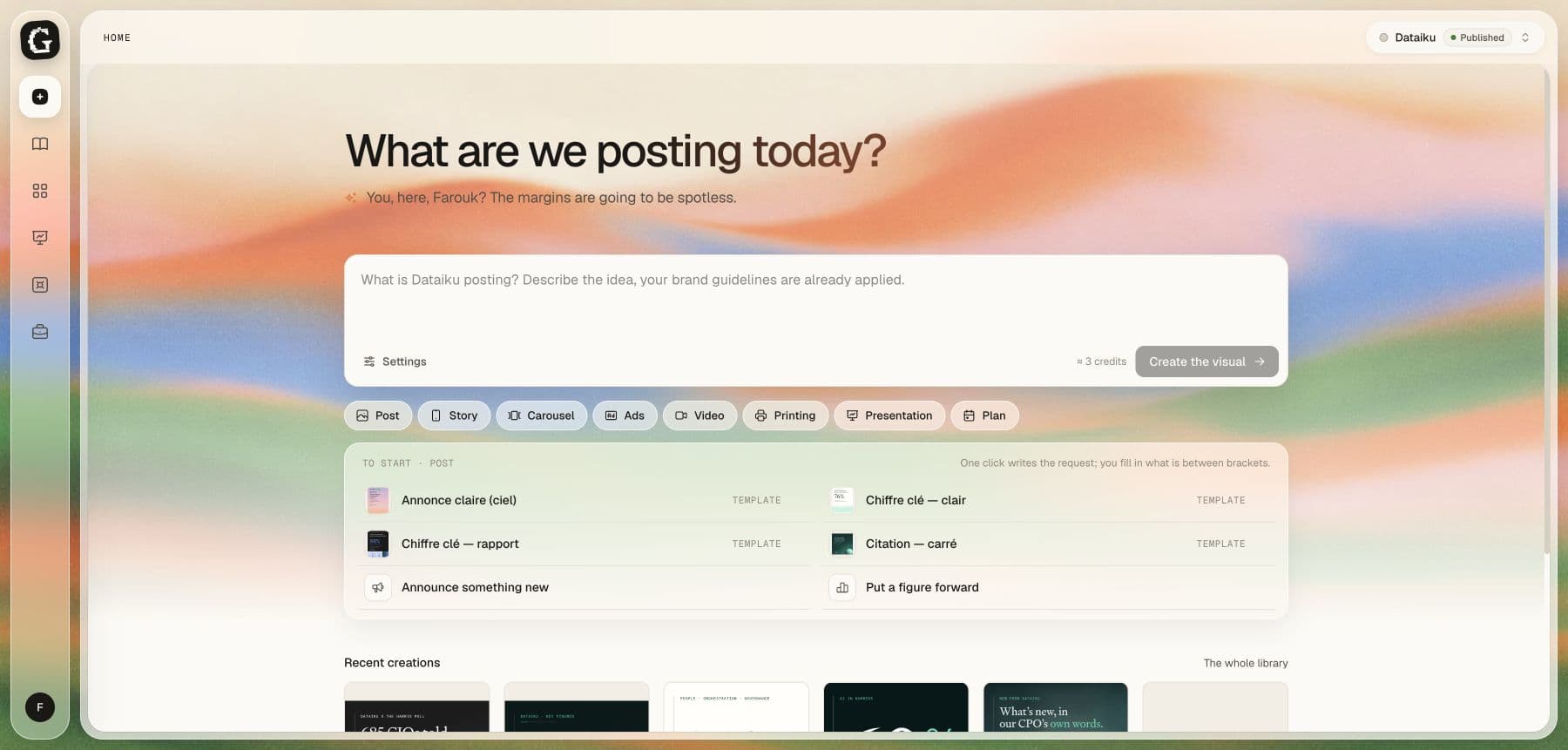
I am developing Graphist to bring brand elements, briefs, creation, editing and export into one workflow. My perspective is also that of a product builder. Evaluate Graphist as you would any other tool: use your own files and check the workflow through to the final revision.
Use a shared comparison framework
| Criterion | For an internal system | For an external tool |
|---|---|---|
| Brand rules | Who codes and updates them? | How are they imported and applied? |
| Editable sources | Where are they saved? | What can you retrieve and modify? |
| Review | Who authorises each stage? | Can work be reviewed before distribution? |
| Integrations | Who maintains connections? | Are the necessary tools supported? |
| Operations | Who resolves incidents? | What support and limits are documented? |
| Portability | Can you switch models or engines? | What remains when the subscription ends? |
Total cost includes brand preparation, configuration, usage, maintenance and error correction. A cheaper generation may produce a more expensive approved deliverable. Conversely, a larger initial investment can make sense for a distinctive, recurring need. Measure these factors in your own context instead of relying only on subscription prices.
Run a pilot that resembles real work
Choose a small set of representative briefs and give them to both approaches. Include an overlong headline, incomplete content and a revision after initial approval. Keep brand files and evaluation criteria identical so that the two options solve the same problem.
Record preparation time, time to approved output, revisions and whether the source can be reused. Ask someone other than the system’s creator to complete the workflow. If they require constant assistance, the operational cost has changed form rather than disappeared. Include that support time in the comparison, along with the effort required to make the next campaign.
Choose what the team can maintain
I recommend building internally when you have a distinctive, recurring requirement, a usable library and someone who can maintain the integrations. If the project will depend on its creator’s availability, budget for that dependency. It will affect every change to the brand or tools.
An external tool is appropriate when its workflow covers your needs and you can retrieve the sources you need. Request a demonstration using your own files, then ask a future user to make a revision. This reveals limitations the vendor’s examples may not show.
You can also keep brand rules in your own repository and use a tool for composition. Assign one authoritative reference to each resource. Base the decision on the pilot, with an estimated cost per approved deliverable, a named owner and a review date.